English
 عربى
عربى
 Español
 русский

News
Home / News / Industry News / Data Center Rack Density: Power, Cooling, and Cabinet Requirements Explained
A facilities manager planning a new AI inference cluster asks a deceptively simple question: what rack density should I design for? The honest answer has changed faster than most infrastructure plans. According to the AFCOM 2026 State of the Data Center Report, average rack density reached 27 kW per rack, up from 16 kW the previous year. At the same time, more than 80% of production racks still run below 30 kW, while AI-focused builds are already designed at 100 kW, 200 kW, and beyond. That spread is not noise: it is the single biggest input into cabinet construction, power distribution, and cooling design today.
Content
Rack density is the total IT power draw in a single rack, expressed in kilowatts per rack (kW/rack). It is a practical proxy for how much compute lives in one footprint. A general-purpose rack drew about 5 kW twenty years ago; many AI deployments now plan for 100–300 kW. Reviews of major US AI data center builds show the shift from roughly 5 kW to 300+ kW per rack happened in about two decades.
The climb is driven by GPU servers, high-core-count CPUs, and dense storage nodes. Even mainstream virtualization hosts now exceed the power envelopes of older equipment. As a result, operators think in three bands: mainstream racks at 8–15 kW, high-density racks at 20–40 kW, and AI racks above 100 kW. The 27 kW AFCOM average sits right at the high end of what conventional air cooling can handle comfortably.
Designers should treat these figures as planning inputs, not targets. A 30 kW average across a hall is very different from ten 30 kW racks in one row. Density planning is local: what matters is the peak load in a specific row, aisle, or cabinet group, not the facility average.
Most facilities do not need a 300 kW rack. Industry surveys consistently show that more than 80% of production racks remain below 30 kW. For standard web, storage, and virtualization workloads, a 10–15 kW per rack design with reserved power headroom is still the sensible starting point.
The real risk is picking the wrong extreme. Designing for 10 kW makes it difficult to accept a single GPU pod later; designing for 100 kW where the workload never exceeds 25 kW wastes capital on cooling and power equipment that will sit idle. Density tiers help match the cabinet and infrastructure to the workload.
| Density tier | Power per rack | Typical workloads | Cabinet depth | Primary cooling |
|---|---|---|---|---|
| Traditional | 5–10 kW | Web, storage, general IT | 600–900 mm | Raised-floor air |
| High density | 15–40 kW | HPC, VDI, dense virtualization | 900–1100 mm | Contained air / rear-door HX |
| AI / GPU | 40–120 kW | Training, inference, LLM serving | 1100–1200 mm | Hybrid or liquid |
| Extreme | 200–350 kW | Large model training clusters | Custom | Direct liquid cooling |
The pattern is consistent: as density rises, the cabinet must become deeper, the door more open to airflow, and the power feed more dedicated. Skip any one of those and the rack becomes the bottleneck.
When a rack passes 20 kW, power distribution becomes as critical as server selection. Every high-density rack needs a defined power path, and mission-critical deployments usually get two independent A/B feeds so a single breaker or UPS event does not take down an entire row.
The rack-mount PDU is the final meter of that path. At 27 kW average, a 30 A or 60 A three-phase feed is common; above 50 kW per rack, a dedicated busway or a separate circuit is usually required. Intelligent PDUs with per-outlet metering help operators track real per-rack load and catch overloads before breakers trip. The choice of PDU is no longer an afterthought; it is part of the density plan.
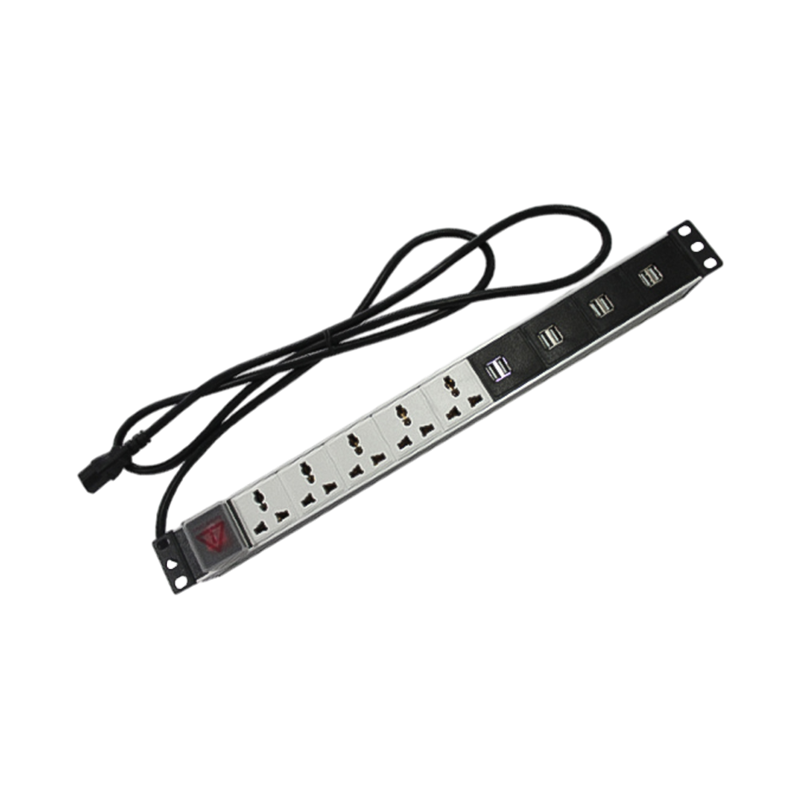 Switched Rack PDU with Per-Outlet Metering for Density PlanningThis intelligent PDU provides per-outlet power monitoring and remote switching, helping operators track real rack load and prevent overloads at 27 kW and above, making it a key part of high-density deployments.View Product →
Precision air works well up to roughly 20–30 kW per rack when paired with hot-aisle/cold-aisle containment. Beyond 40 kW, air alone becomes physically impractical because the airflow volume needed to remove that much heat is enormous. That is why operators running 45–60 kW racks use rear-door heat exchangers or in-row cooling on closed loops; beyond roughly 100 kW, direct liquid cooling with cold plates is the standard approach.
Containment strategy matters as much as the cooling unit. Hot aisle containment and cold aisle containment are the two dominant layouts for high-density environments. Both keep supply and return air from mixing, which stabilizes inlet temperatures and lets the cooling plant run more efficiently. Structured airflow management in network cabinets has a direct effect on how much cooling capacity is actually available at the rack inlet.
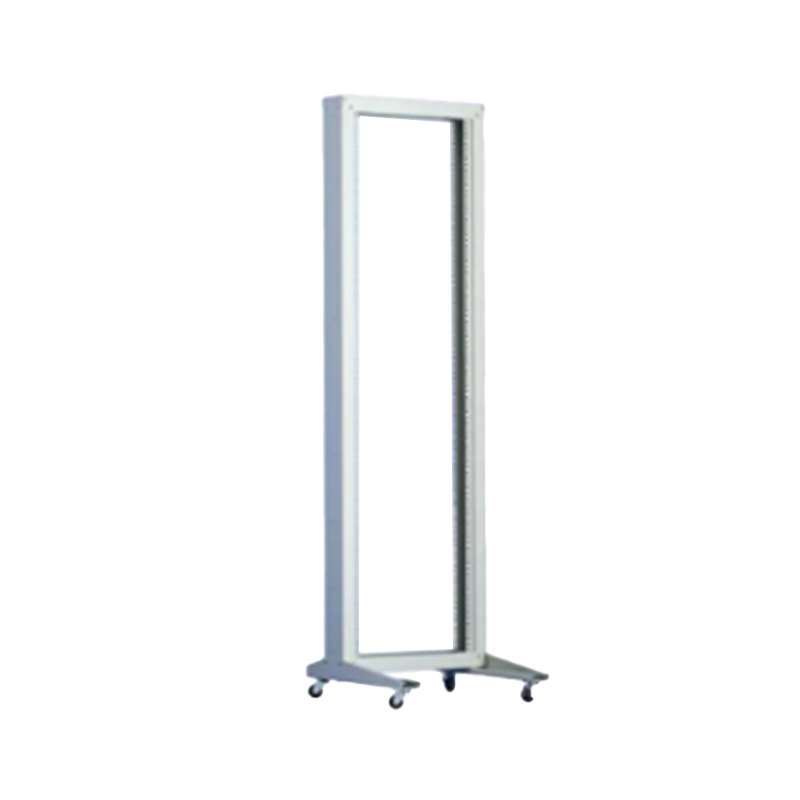
For GPU-heavy clusters, open racks are increasingly common because they free the airflow path and simplify plumbing and cable access. An open four-post frame is often the most practical choice for high-density AI pods, provided the facility manages aisle containment and security separately.
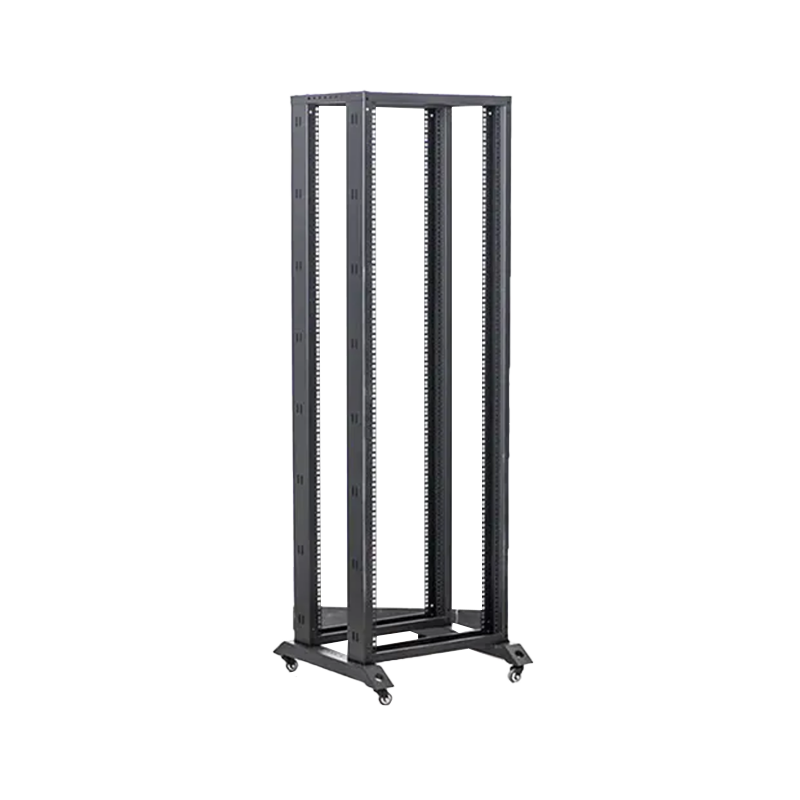 Four-Post Open Frame Rack with Modular and Tool-Less FeaturesThis open four-post rack offers stability, integrated PDU options, and tool-less assembly, suited for high-density GPU clusters where airflow and cable access matter more than enclosure.View Product →
High density stresses the cabinet itself, not just the power and cooling plant. Three physical limits show up in practice: depth, static load, and cable space.
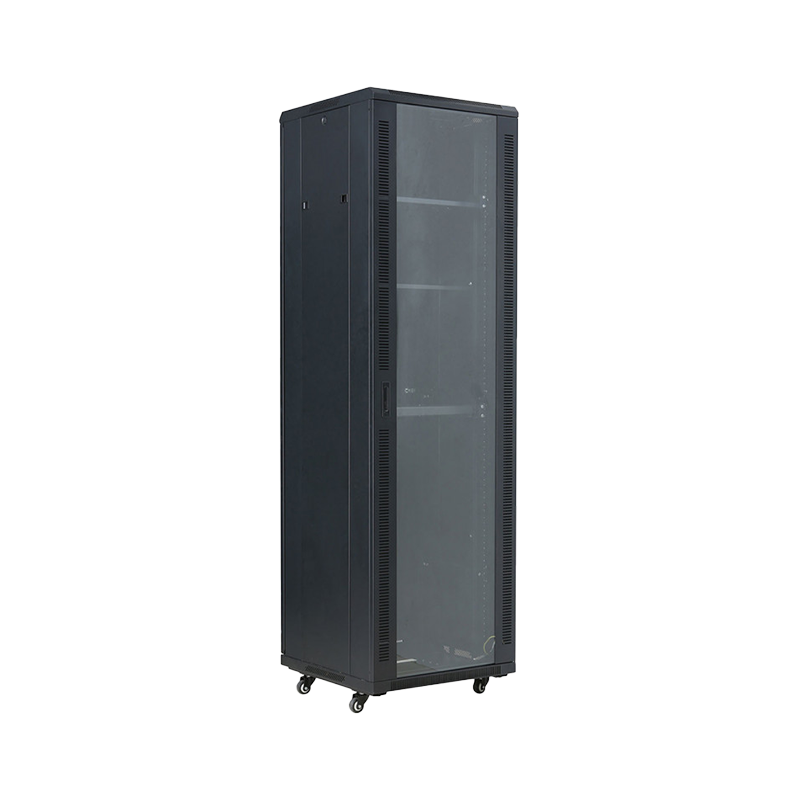
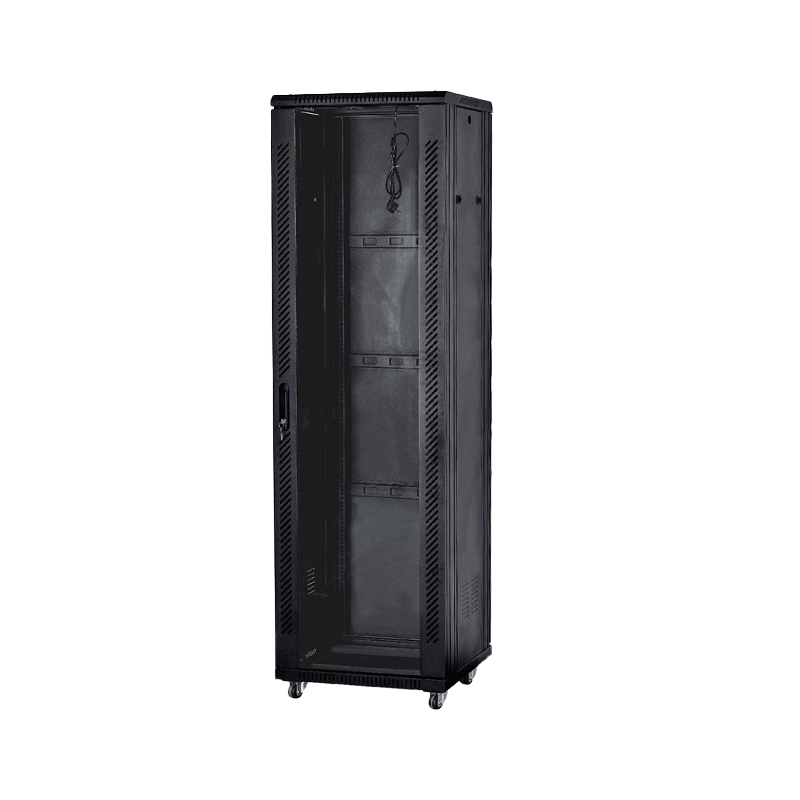
Modern high-density servers are long. A cabinet with less than 1000 mm usable depth forces sharp cable bends and blocks rear airflow. The static load rating of the frame must also match the total mass of installed servers; high-loading cabinets are rated for exactly this duty, and under-rated frames can sag when mounted hardware is serviced. Finally, cable volume scales with density: vertical cable managers, brush panels, and tidy routing are necessary to keep service access usable.
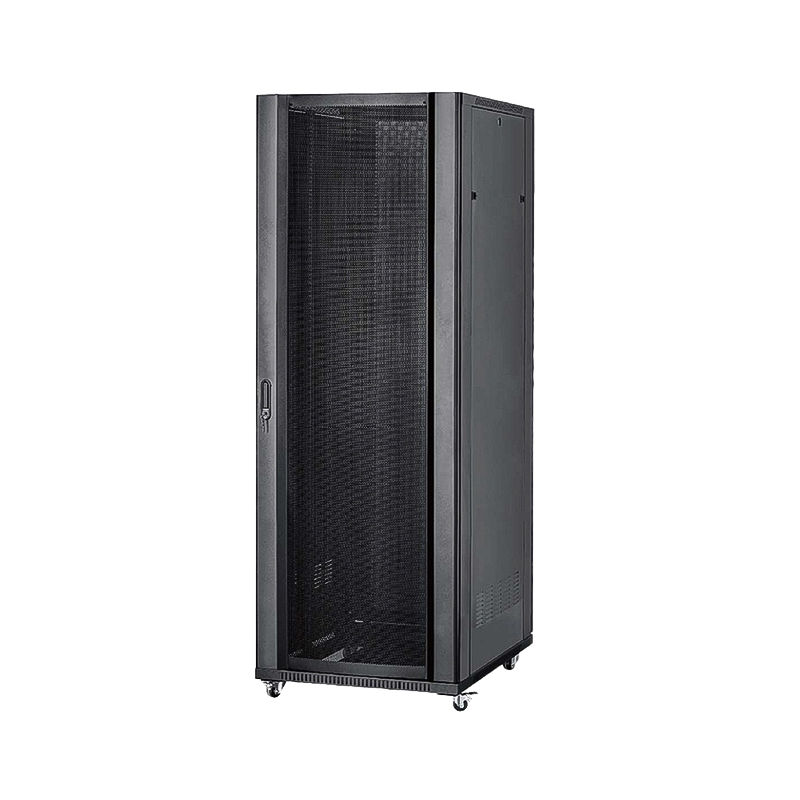
Front doors deserve special attention. A solid glass door can look good, but it restricts airflow and raises inlet temperatures in dense builds. Perforated doors with high open-area ratios, paired with blanking panels for unused U positions, keep air moving through equipment instead of around it.
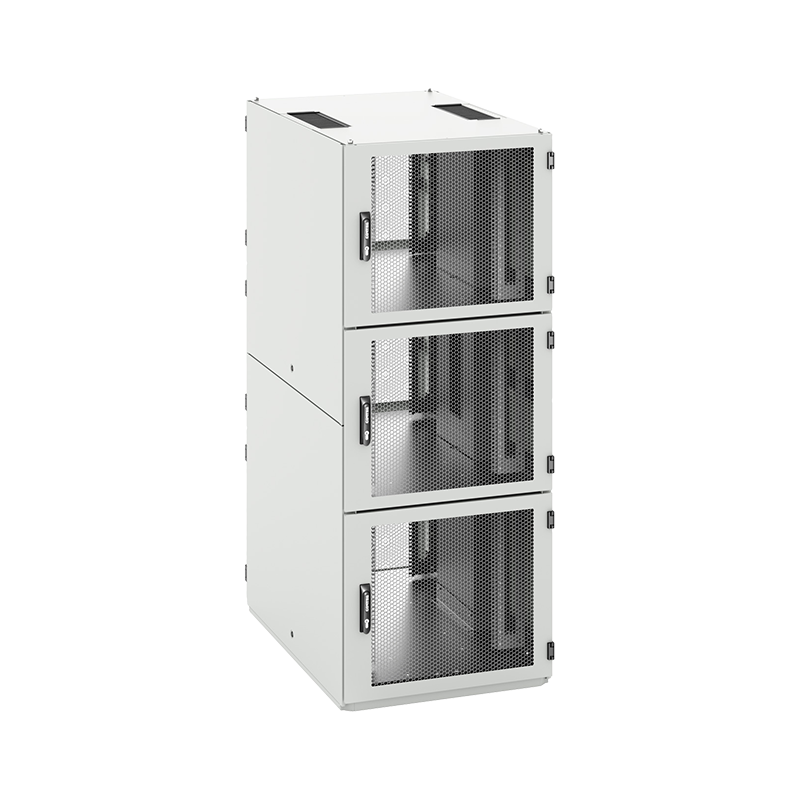
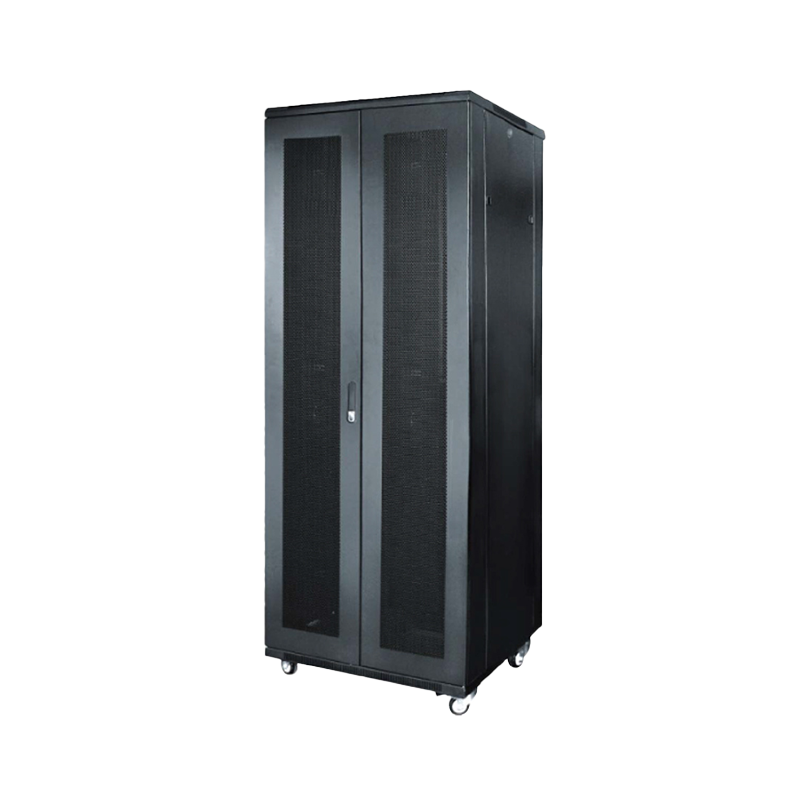
The diagram shows the physical elements that matter in a high-density cabinet: the perforated door, the vertical cable channel along the leading edge, and the airflow path from cold inlet to rear exhaust. Heavy-duty server cabinets with reinforced frames and high open-area doors are the practical answer when density exceeds 20 kW per rack. Whenever possible, work with a network cabinet manufacturer that can align cabinet depth, door open-area ratio, and cable management with a specific density target.
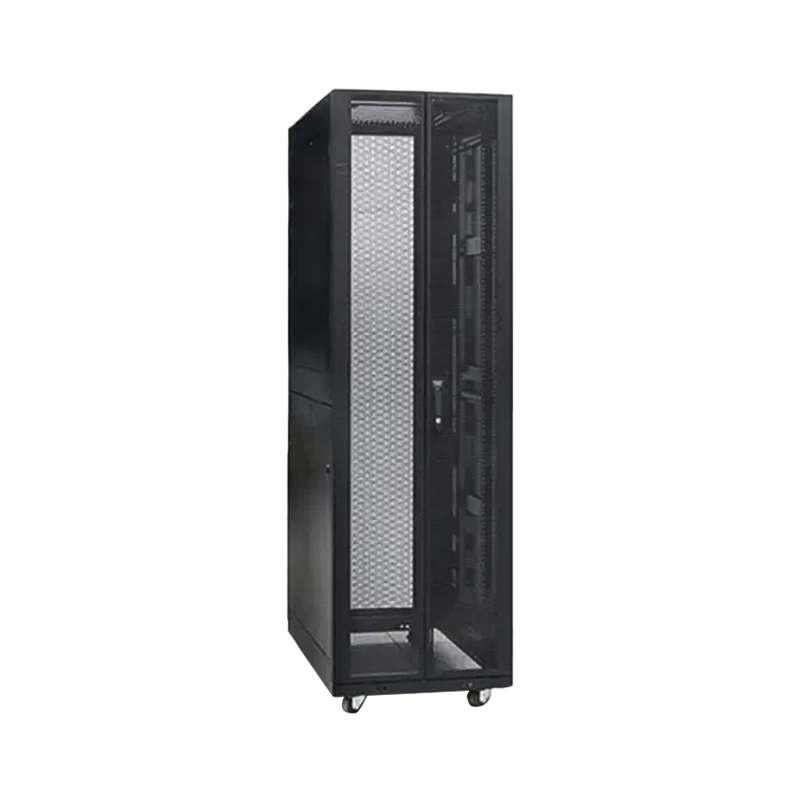 Heavy-Duty Server Cabinet with Segmented Side Doors and High VentilationThis reinforced cabinet uses high open-area mesh doors and independently opening side panels to improve airflow and service access, making it practical for racks exceeding 20 kW per rack.View Product →
Rack density is the IT power load per rack, measured in kW/rack. It shows how much compute is packed into one cabinet and drives power, cooling, and cabinet decisions.
According to the AFCOM 2026 State of the Data Center Report, the average is 27 kW per rack, up from 16 kW a year earlier. Most production racks still run below 30 kW.
A standard 42U air-cooled cabinet handles roughly 15–30 kW with containment. With rear-door heat exchangers, 40–60 kW is practical; above that, liquid cooling is typical.
There is no fixed threshold, but most operators move beyond precision air between 30 and 40 kW per rack. Some run 45 kW on rear-door heat exchangers before going full liquid.
Add the rated or measured power draw of every device in the rack. For example, 20 servers at 1.2 kW each equals 24 kW/rack. Intelligent PDUs give real measured numbers.
Yes. Open racks improve airflow, cable access, and hardware swaps, which is why many GPU clusters use four-post open racks. Budget for containment and security separately.
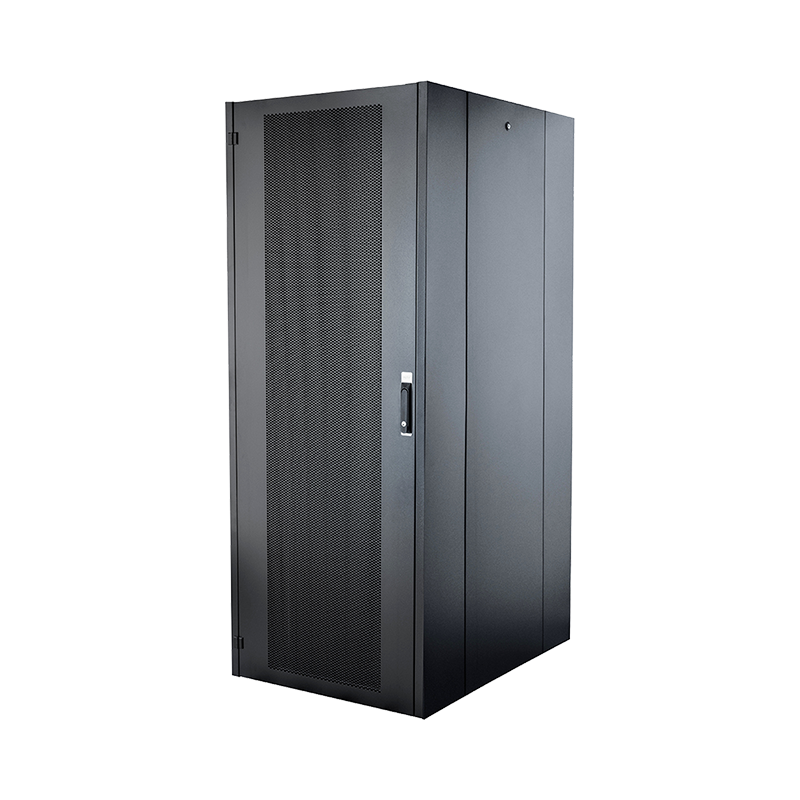




We are a company mainly engaged in the manufacturing of network cabinet , charging cart and other infrastructures.
Product Classification
Address
No.12 Fushan Road,Guanhaiwei Town,Cixi City,Ningbo,Zhejiang,China
PHONE
+86-17857397994